
 Technical Bulletins
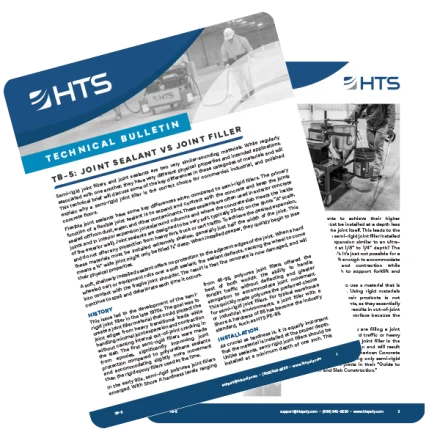
Semi-rigid joint fillers and joint sealants are two very similar-sounding materials. While regularly associated with one another, they have very different physical properties and intended applications. This technical brief will discuss some of the key differences in these categories of materials and will explain why a semi-rigid joint filler is the correct choice for commercial, industrial, and polished concrete floors.
Flexible joint sealants have some key differences when compared to semi-rigid fillers. The primary function of a flexible joint sealant is to expand and contract with the concrete and keep the joints sealed off from dust, water, and other contaminants. These sealants are often used in exterior concrete joints and in interior expansion joints(around columns and where the concrete slab meets the inside of the exterior wall). Joint sealants are designed to be very soft, typically 25-40 on the Shore “A” scale, and do not offer any protection from heavy fork truck or cart traffic. To achieve the desired expansion, these materials must be installed extremely shallow, generally just half the width of the joint. This means a 1/4” wide joint might only be filled 1/8” deep. When installed deeper, they quickly begin to lose their physical properties.
A soft, shallowly installed sealant offers no protection to the adjacent edges of the joint. When a hard wheeled cart or equipment rolls over a soft sealant, the sealant deflects, causing the wheel to come into contact with the fragile joint shoulder. The result is that the concrete is now damaged, and will continue to spall and deteriorate each time it occurs.
HISTORY
This issue led to the development of the semi-rigid joint filler in the late 1970s. The goal was to create a joint filler material that could protect the joint edges from heavy transitional loads while handling minimal joint expansion and contraction without causing internal out-of-joint cracking in the slab. The first semi-rigid fillers were made from epoxies, significantly improving joint protection compared to polyurethane sealants and accommodating slightly more movement than the rigid epoxy fillers used at the time.
In the early 90s, semi-rigid polyurea joint fillers emerged. With Shore A hardness levels ranging from 45-95, polyurea joint fillers offered the best of both worlds: the ability to handle forklift traffic without deflecting and greater elongation to accommodate joint movement. This quickly made polyurea the preferred choice for semi-rigid joint fillers. For typical warehouse or industrial environments, a joint filler with a Shore A hardness of 85 has become the industry standard, such as HTS PE-85.
INSTALLATION
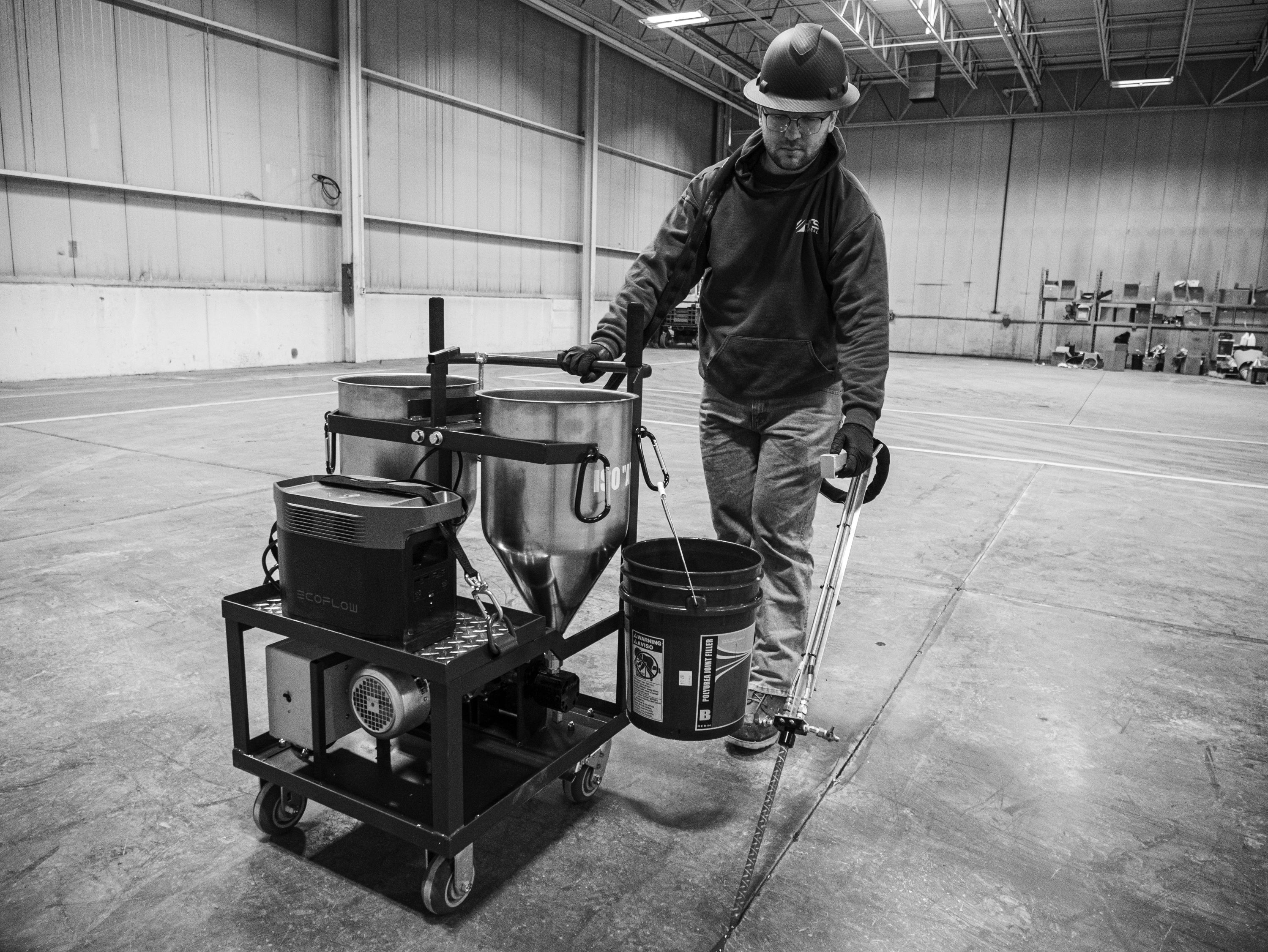
As crucial as hardness is, it is equally important that the material is installed at the proper depth. Unlike sealants, semi-rigid joint fillers should be installed at a minimum depth of one inch. This ensures proper sidewall adhesion to prevent “push down” from heavy transitional loads. Saw-cut joints are generally cut at 25% of the slab depth. A full-depth fill (meaning the full depth of the saw cut or 2 inches minimum in construction joints) is recommended to provide proper joint shoulder protection in facilities with multiple forklifts. For facilities with a single forklift and light to medium-weight hard-wheel cart traffic, a 1-inch minimum depth fill is recommended.
Due to the similarities in name and their proximity of usage, there is sometimes confusion about when to specify a joint sealant or a semi-rigid joint filler. Some manufacturers and suppliers may imply more expansion or elongation than the joint filler can accommodate. Elongation percentage has become an industry-standard measurement included on every joint fill tech data sheet. However, since concrete expansion and contraction joints expand laterally from side to side, the elongation lengthwise does not provide much insight into the material’s performance.
 For softer sealants to achieve their higher expansion, they must be installed at a depth less than the width of the joint itself. This leads to the question: How can a semi-rigid joint filler installed at full depth offer expansion similar to an ultra-soft sealant installed at 1/8” to 1/4” depth? The short answer is, it can’t. It’s just not possible for a material to be both soft enough to accommodate extreme expansion and contraction while remaining hard enough to support forklift and equipment traffic.
 It is also important not to use a material that is too rigid to fill the joint. Using rigid materials like crack and spall repair products is not recommended for filling joints, as they essentially weld the slab together. This results in out-of-joint cracking visible at the slab surface because the joints cannot move.
The bottom line is that if you are filling a joint that will see any hard-wheeled traffic or heavy transitional loads, a semi-rigid joint filler is the best material for the application and will result in a longer-lasting floor. The American Concrete Institute agrees, recommending only semi-rigid joint fillers for saw cut joints in their “Guide to Concrete Floor and Slab Construction.”
