New video: See how HTS products are made in America!
Watch Here
➔

100% solids and water-based epoxy floor coating systems with primers for warehouses, manufacturing, pharmaceutical, and commercial facilities.
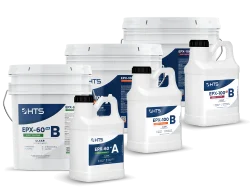
An epoxy coating is a two-component floor coating system consisting of a resin and a hardener that chemically crosslink to form a dense, durable film on the concrete surface. Epoxy floor coatings are among the most widely used concrete floor finishes in commercial, industrial, and institutional environments because they provide excellent adhesion, chemical resistance, abrasion resistance, and a seamless, easy-to-clean surface.
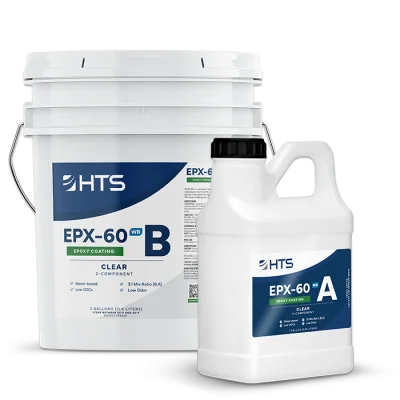
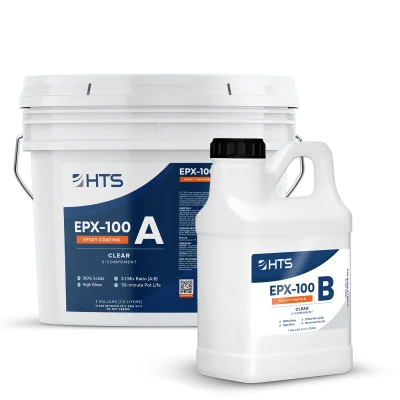
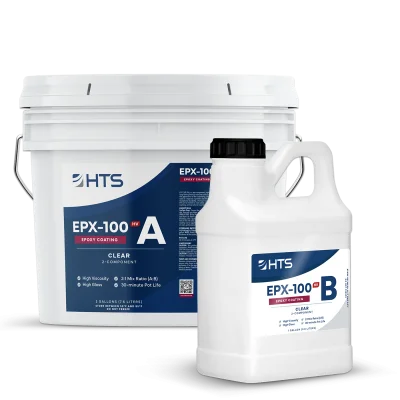
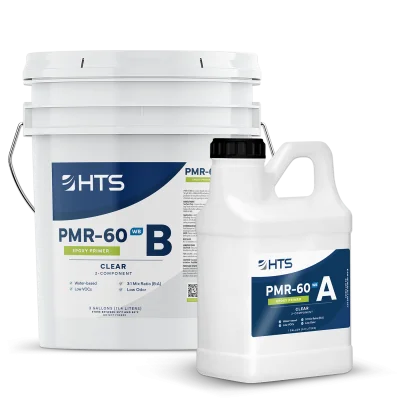
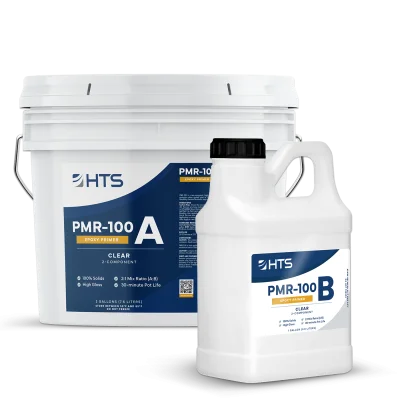
HTS Chemical manufactures a complete epoxy coating system for every project requirement. EPX-100 is a 100% solids, two-part epoxy with a 2:1 mix ratio that delivers a high-gloss finish with low VOCs, excellent chemical resistance, and mold and mildew resistance. EPX-100 HV is a high-viscosity variant with the same performance properties, designed for thicker film builds and recommended for clean rooms, pharmaceutical facilities, and hospitals. EPX-60 WB is a water-based epoxy with less than 50 g/L VOCs for occupied buildings and projects requiring solvent-free application. PMR-100 is a high-solids epoxy primer with less than 5 g/L VOC, and PMR-60 WB is a water-based primer, both formulated to maximize adhesion as a base coat.
All HTS epoxy products are available in custom-tinted solid colors from the HTS color chart and are compatible with Torginol decorative flake for broadcast chip floor systems. Torginol flake can be broadcast into wet epoxy to create seamless, slip-resistant decorative floors commonly used in commercial kitchens, restrooms, locker rooms, and retail spaces. See the HTS Color Chart for the full range of epoxy pigments and Torginol color blends.
For maximum performance, a 100% solids system (EPX-100 or EPX-100 HV over PMR-100 primer) delivers the thickest film build with no solvent evaporation. EPX-100 HV's higher viscosity makes it the better choice when a thicker single-coat application is needed. For projects requiring water-based application, EPX-60 WB over PMR-60 WB provides a low-VOC system, though the EPX-60 WB TDS notes that a 100% solids epoxy primer is preferred for maximum adhesion. For decorative applications, broadcast Torginol flake into the wet EPX-100 or EPX-100 HV base coat and seal with a clear polyaspartic topcoat (PAS-100 or PAS-200) for UV stability and scratch resistance. The concrete substrate must be profiled to ICRI CSP 2-3 and the moisture vapor emission rate must not exceed 3 lbs/1000 sq ft per 24 hours.
Surface preparation is the single most important factor in the success of any epoxy floor coating project. No matter how advanced the epoxy coating is, it will fail if the concrete substrate is not properly profiled, cleaned, and free of contaminants. The industry standard is to achieve a Concrete Surface Profile (CSP) of 2-3 for most epoxy systems, which can be accomplished through diamond grinding, shot blasting, or scarification depending on the condition of the existing floor.
Before applying any floor coatings, the concrete must be tested for moisture vapor emissions (MVER) and relative humidity (RH). Excessive moisture is the leading cause of epoxy coating failures, causing blistering, bubbling, and delamination. HTS epoxy primers handle normal moisture conditions, but slabs with elevated MVER or RH readings may require a moisture mitigation system before coating. All oil, grease, curing compounds, sealers, and other contaminants must be removed to ensure the epoxy can bond directly to clean concrete.
For contractors who need to use epoxy to fix concrete surface defects, HTS repair materials can be used to fill cracks, spalls, and bug holes prior to priming and coating. A smooth, defect-free substrate produces the best finished appearance and ensures uniform coating thickness across the entire floor. Taking the time to prepare the surface correctly is what separates a professional concrete floor finish from a coating that fails within months.
Epoxy floor coatings serve a wide range of applications across nearly every industry. Warehouses and distribution centers use epoxy systems for their abrasion resistance and seamless, easy-to-clean surfaces. Manufacturing plants rely on epoxy coatings to protect concrete from chemical spills, impact damage, and heavy machinery traffic. Food and beverage facilities choose epoxy concrete floor finishes that meet USDA and FDA requirements for sanitary flooring.
Healthcare, pharmaceutical, and clean-room environments use EPX-100 HV for its mold and mildew resistance and high-viscosity formula that provides uniform coverage on smooth substrates. Commercial kitchens, breweries, and processing plants benefit from the chemical resistance and washdown compatibility of 100% solids epoxy systems. Retail environments, showrooms, and automotive dealerships use tinted epoxy floor coatings for a high-gloss, professional appearance that withstands daily foot and vehicle traffic. In aerospace, military, and government facilities, epoxy systems meet the stringent performance and compliance requirements of federal specifications.
Let’s get to work.
Speak to an HTS sales rep in your area to discuss your project. We look forward to helping you be successful.
Find a Sales Rep